Collections

MoMA(The Museum of Modern Art)

・An Expression

MoMAホームページ

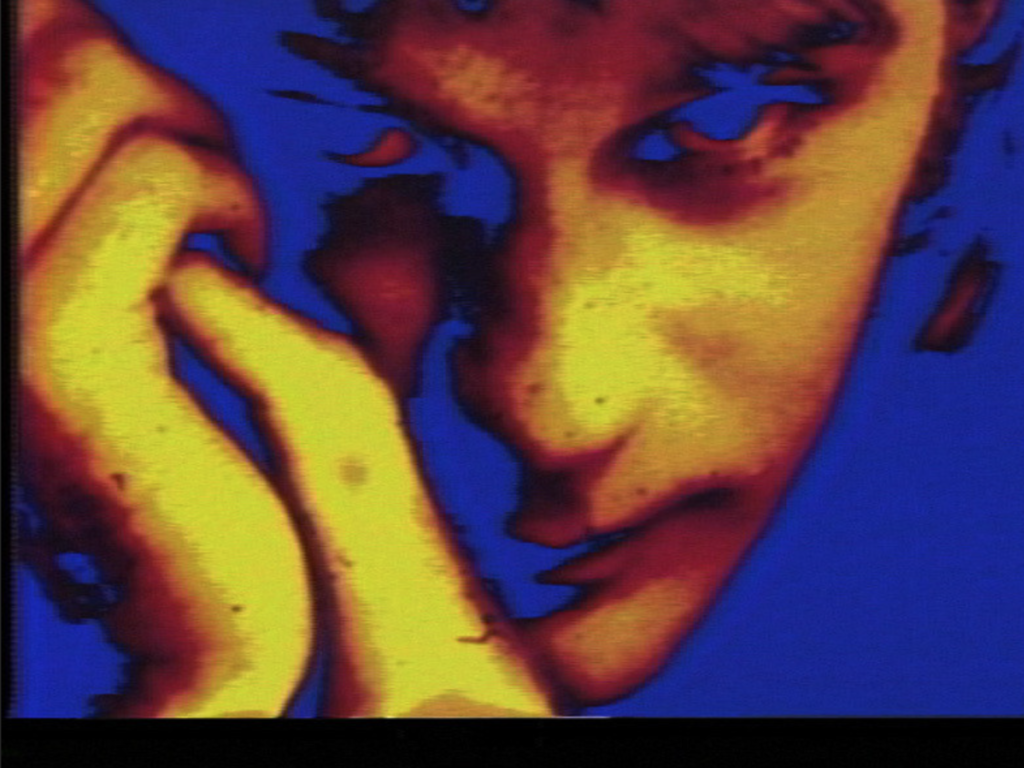
An Expression is a seminal work in Naoko Tosa’s early video art that fundamentally reconfigures the relationship between image, sound, and the body.
In this piece, a system is constructed where images of collected facial expressions are arranged along a timeline. A light sensor reads the fluctuations in brightness and darkness, converting them into sound in real-time. Crucially, the image does not accompany the music, nor does the sound merely complement the image. Instead, the two are causally linked: the shifts in the visual field directly become sound, and that sound, in turn, alters the perception of the image. The work does not “express” a relationship between the visual and the auditory; rather, it presents the very mechanism through which that relationship is generated.
Furthermore, while the work centers on the theme of “facial expressions,” it does not express emotion. Individual faces do not carry meaning or narrative; they are treated as a mere distribution of light whose variations are translated into sound. Here, emotion is not something to be decoded by the viewer, but a phenomenon that emerges within the system itself.
In this regard, An Expression already contains the philosophy of “emergence” found in her later work, Sound of Ikebana. While Sound of Ikebana features sound acting upon fluids to create form, An Expression uses the flux of light and time to generate sound, allowing sensation itself to arise.
Ultimately, An Expression is not a video work. It is a process in which the invisible connections between the visual, the auditory, and the physical are exposed through the passage of time.


The National Museum of Art, Osaka

ECSTASY

https://tosa.dpri.kyoto-u.ac.jp/wordpress/wp-content/uploads/2020/07/1986-ECSTACY.pdf

ECSTASY (1986) Early Video Art: Where the Body Becomes Image and Sensation Becomes Form
ECSTASY is an early video art piece created by Naoko Tosa in 1986. By synthesizing live-action footage of a female torso with computer graphics, the work manifests internal sensations that usually lack physical form—such as self-transcendence and euphoria—as sculptural visual images. It was showcased at numerous international festivals, including the SIGGRAPH Animation category in 1986.
A crucial element of this work is that the body is not merely a subject. The female body appearing on screen is not an icon used to explain desire or pleasure. Through the layering of live-action video, CG, color, and granular transitions, the body appears not as fixed flesh, but as a “site” where sensation is generated.
The sequence features a female torso, a body turning into particles, flesh illuminated in red, hands touching skin, and green organic/fluid images flowing vertically. Here, the body loses its stable contour; it is decomposed, transformed, and transitions into other substances or natural imagery. In essence, ECSTASY is not a work that films the body, but one that deals with the process of the body transforming into “the image.”
From an art historical perspective, ECSTASY stands at a vital intersection of 1980s video art and computer graphics. At the time, CG was often treated as a technical novelty. However, Tosa utilized CG not for futuristic visual effects, but to externalize the invisible sensations residing within the body. This is where the work’s radicalism lies.
The piece received significant international acclaim, winning an award at the SIGGRAPH Art Show in 1987 and the BACA’s 21st Annual Film-Video Festival in 1988. It was also featured in exhibitions such as WAVEFORMS: VIDEO FROM JAPAN, the ACM/SIGGRAPH Traveling Art Show “25 years of Computer in the Arts”, Image du Futur ’87, and the Experimental Media Festival: MIAMI WAVES. These inclusions clearly position the work within the context of late 1980s international video and computer art.
Furthermore, ECSTASY already contains the philosophical seeds of Tosa’s later Sound of Ikebana. In Sound of Ikebana, sound and voice act upon fluids to generate fleeting forms invisible to the naked eye. In ECSTASY, the collision of the body, CG, and video editing generates the invisible sensations of trance and ecstasy as visual form.
Ultimately, ECSTASY is not a work that “represents” the body. It deals with the exact moment when the invisible sensations inside the body begin to take shape as an image. In this sense, the work foreshadowed as early as the 1980s the core of Tosa’s later philosophy: dealing not with representation, but with emergence.
While Sound of Ikebana captures the moment before nature takes form, ECSTASY captures the moment before physical sensation takes form. Consequently, ECSTASY goes beyond a mere technical experiment in early CG and video art; it is a work that marks the transition from seeing the body as an image to treating the body as a site of generation.


Toyama Prefectural Museum of Art & Design

GUSH!

“Cinematic Cubism” After David Hockney
GUSH! is a seminal early work by Naoko Tosa that radically examines the relationship between the body, time, and perspective. In this piece, a Butoh dancer is filmed in real-time from six different angles using six cameras. Each video feed is fragmented via digital frame memory and then collaged and reconstructed along a timeline.
The work serves as a response to David Hockney’s photo-collage pieces. Hockney combined multiple photographs to construct a single frame that captured overlapping layers of time and space—something impossible via a single-point perspective. GUSH! transitions this methodology from static photography to moving images and physical motion. Essentially, GUSH! reinvents Hockney’s multi-perspective collage within the temporality of video.
A crucial point here is that the dancer’s body is not merely being filmed. The body is not an object to be grasped from a single vantage point; instead, it is dismantled and reassembled through multiple cameras, fragmented frames, and temporal shifts. While Hockney used photography to break the unity of vision, Tosa uses video to break the unity of the body. In this sense, GUSH! is not a mere showcase of video effects. It refuses to view the body as a “single form,” instead treating it as an event generated by perspective, time, and media.
From an art historical perspective, this work connects Cubism, Hockney’s photo-collages, and the video art of the 1980s and beyond. Tosa’s originality lies in her refusal to simply arrange multiple viewpoints on a screen; instead, through physical movement and real-time video processing, she turns the process of form emerging within time into the work itself.
Therefore, GUSH! is not a documentary of a dance, nor is it an expression of the body. It is a work that deals with the conditions under which the body is generated within a visual medium. While ECSTASY manifested internal sensations as images, GUSH! dismantles and regenerates the body’s external form through fragments of time and perspective.
There is a clear lineage here leading to her later work, Sound of Ikebana. In Sound of Ikebana, sound acts upon fluids to generate fleeting forms invisible to the naked eye. In GUSH!, multiple perspectives and temporal fragments act upon the body to generate its form as a visual image. In short, GUSH! anticipated Tosa’s exploration of “emergence”—not through natural phenomena, but through the realm of the body and media.
To put it most sharply: While Hockney spatialized time through photography, Naoko Tosa attempted the “emergentization” of the body through video.


Takamatsu Art Museum

Pleasure

The Reversal of the Gaze: Emergence within the Theatrical Space
Pleasure is a seminal early work by Naoko Tosa that radically examines the relationships between image, body, space, and the gaze. This piece was utilized within the stage productions of “NOISE,” a theater company led by playwright Koharu Kisaragi, positioning it at the critical intersection of theater and media in the 1980s.
This context is of decisive importance. Here, the video is not screened as an independent work; instead, it functions in synthesis with the body, language, and sound within a live theatrical space. Pleasure exists not as an image on a screen, but as an element that alters the very quality of the theatrical environment.
In this work, live-action footage of waves, flames, and eyes is processed through 3D Digital Video Effects (DVE) to construct a visual environment that envelops the audience. Of particular significance is the recurring imagery of the “eye.” Normally, the audience is the subject that views the image. However, in Pleasure, this relationship is inverted. The audience does not look at the image; the image looks at the audience.
This effect is further intensified by the theatrical space. The spectators are no longer safe observers outside the frame; they are exposed to the gaze of the image within the same physical space as the actors. In essence, the spectator becomes both “the one who sees” and “the one who is seen.” Here, the image is not merely visual information. It is a device that generates the gaze itself, acting as a force that destabilizes the spectator’s perceptual position.
From an art historical perspective, Pleasure illustrates the process by which video art was liberated from the monitor and integrated into the relationships between space, body, and audience. Simultaneously, it is an attempt to reorganize the structure of the gaze in theater through the medium of video.
Crucially for Tosa’s oeuvre, the problem of “emergence” already manifests here. What is generated in Pleasure is not the image itself, but a situation in which the following collapse:
The premise that the audience is viewing.
The position of the audience as being “outside.”
The unidirectionality of the gaze.
The work does not exist “inside” the screen; it arises within the relationship between image, body, stage, and audience.
If An Expression generates the relationship between sight and sound, ECSTASY generates internal physical sensations, and GUSH! reconstructs the form of the body within time, then Pleasure is the work that regenerates the very act of “viewing.” In this sense, it constitutes a vital precursor to the later Sound of Ikebana. While Sound of Ikebana visualizes invisible moments in natural phenomena, Pleasure manifests the moment when we are looked back at by the world we thought we were merely observing.
Ultimately, Pleasure is a work that deals with the exact moment when gaze and space are generated.


Nagoya City Museum

TRANCE

Where Fractals Become the “Structure of Consciousness” Rather Than a “Geometric Shape”
TRANCE is a 1989 video work by Naoko Tosa. A six-minute piece with color and sound, featuring music by Akio Morimoto, it is currently held in the collection of the Nagoya City Art Museum.
The significance of this work lies in the fact that it does not treat fractals as mere mathematical diagrams. Fractals are self-similar structures found throughout nature—underlying the patterns of clouds, coastlines, trees, blood vessels, nerves, and the flickering of flames. In TRANCE, these structures unfold visually, allowing the viewer not just to “see a shape,” but to experience the sensation of form self-propagating, transforming, and drawing the consciousness into its depths. In essence, TRANCE does not explain fractals; it is a work in which consciousness becomes entangled within fractal generation.
The title TRANCE is vital here. It does not refer to a mere hallucinatory visual, but to a state where ordinary perception wavers and the boundary between form and consciousness becomes unstable. The image is not an external object; it acts upon the viewer’s interior, altering the very rhythm of perception.
From an art historical perspective, TRANCE stands at a crucial junction between computer imagery and video art in the late 1980s. At the time, computer graphics were often regarded simply as a “new imaging technology.” However, Tosa did not use CG as a futuristic ornament. Instead, she utilized it to visualize the mathematical structures underlying nature and the morphological principles that act upon the depths of human consciousness.
In this regard, TRANCE is deeply connected to the later Sound of Ikebana. While Sound of Ikebana features sound acting upon fluids to give rise to fleeting forms invisible to the naked eye, TRANCE features the mathematical structure of the fractal multiplying and transforming within the video to act upon the viewer’s consciousness. What they share is a refusal to represent pre-existing forms; instead, they deal with the process by which form is born, changes, and reaches our awareness.
To put it most sharply for Akira Tatehata: TRANCE is not a visualization of fractals. It is a work that allows the viewer to experience, within the temporality of video, the generative structure common to both nature and consciousness.
If An Expression generated the relationship between sight and sound, ECSTASY visualized internal physical sensations, and GUSH! Reconstructed the body through multiple perspectives and time, then TRANCE is the work that deals with the structures of repetition, proliferation, and self-similarity at the heart of nature and the mind.
As such, this work is a vital precursor to Tosa’s later exploration of “the moment nature emerges.” In TRANCE, nature is not depicted as a landscape. It appears as a mathematical force that gives birth to form. Therefore, the art historical value of TRANCE extends beyond early CG experimentation; it is a work that transformed the moving image from something “to be seen” into a site where the structures of perception and nature resonate.


Kawasaki City Museum

Trip

The Generation of Subconscious Visual Sensation
TRIP is a pivotal work in Naoko Tosa’s early video art that defined the relationship between the rhythm of video editing and physical sensation. The concept of the work was to produce “impactful images that burn into the brain as afterimages in the subconscious,” aiming to relax the tensions of daily life. Tosa herself has noted that it was through this work that she first grasped her unique rhythm of video editing.
The crucial point here is that TRIP is not a narrative video. In this piece, forms and colors undergo metamorphosis, and the phantasmagoric images carry an intense sense of urgency. Rather than explaining a meaning, the video acts directly upon the spectator’s perception and nerves. In other words, TRIP treats the moving image not as an “object to be seen,” but as a force capable of altering states of consciousness.
From an art historical perspective, TRIP represents the point at which Japanese video art in the 1980s moved away from documentation and storytelling. Instead, it began to intervene in the spectator’s physical sensations through the inherent rhythm, color, transformation, and velocity of the medium itself. The work received significant acclaim both domestically and internationally, appearing in exhibitions such as “SCAN ’85 Autumn” at Video Gallery SCAN Tokyo and the 2nd International Biennale Video CD’85. It went on to win an award in the SIGGRAPH ’86 Animation Screening category, a Special Prize at the Japan Video Festival, and 2nd Place in the Video Art category at the 1987 American Film & Video Festival.
To put it most sharply, TRIP is not a work that expresses something through video. It is a work that creates the conditions for a sensation to be generated within the spectator through the rhythm of the medium.
If the latter Sound of Ikebana uses sound to move fluids and give rise to fleeting forms invisible to the naked eye, then TRIP serves as its precursor by using editing, color, and transformation to trigger afterimages, tension, and subsequent release within the spectator’s consciousness. What is generated in TRIP is not a natural phenomenon, but the visual sensation itself that lingers in the subconscious.
In this sense, TRIP is one of the starting points for “emergence” in Tosa’s early oeuvre. It is a work that liberated video from information and narrative, utilizing it instead as a device for the generation of sensation.


Kenninji Temple
Silence

Sansui on the cloud

Dedication to Kennin-ji: Japanese Sanctuary “Silence” and “Landscape Above the Clouds” – Artistic Intent
The work Japanese Sanctuary, dedicated by Naoko Tosa to Kennin-ji Temple, is far more than a mere digital expression of “Japanese beauty.” According to the temple’s records, the work is described as an expression of the “stillness” and “dynamism” rooted in Zen and Shinto, consisting of two distinct pieces: Silence and Landscape Above the Clouds.
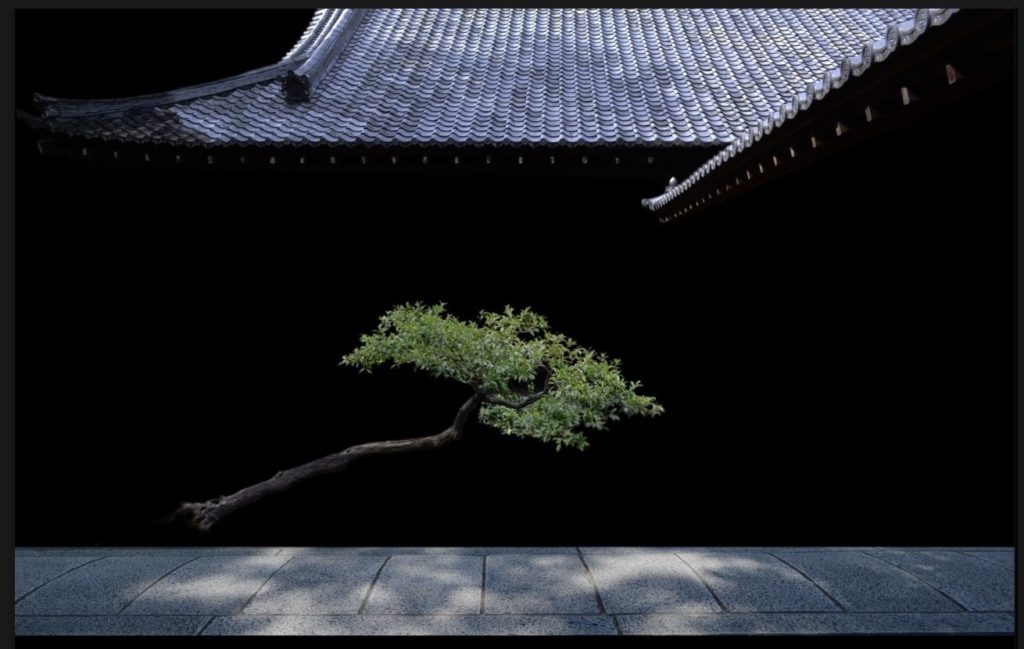
Silence centers on a 200-year-old mochinoki (holly tree) that once stretched diagonally across the Kennin-ji garden. The tree collapsed under heavy snow a few years ago and no longer exists. Consequently, this work does not simply document lost nature; it is an attempt to re-invoke the time, memory, and presence of that vanished tree within the sacred space of Kennin-ji.
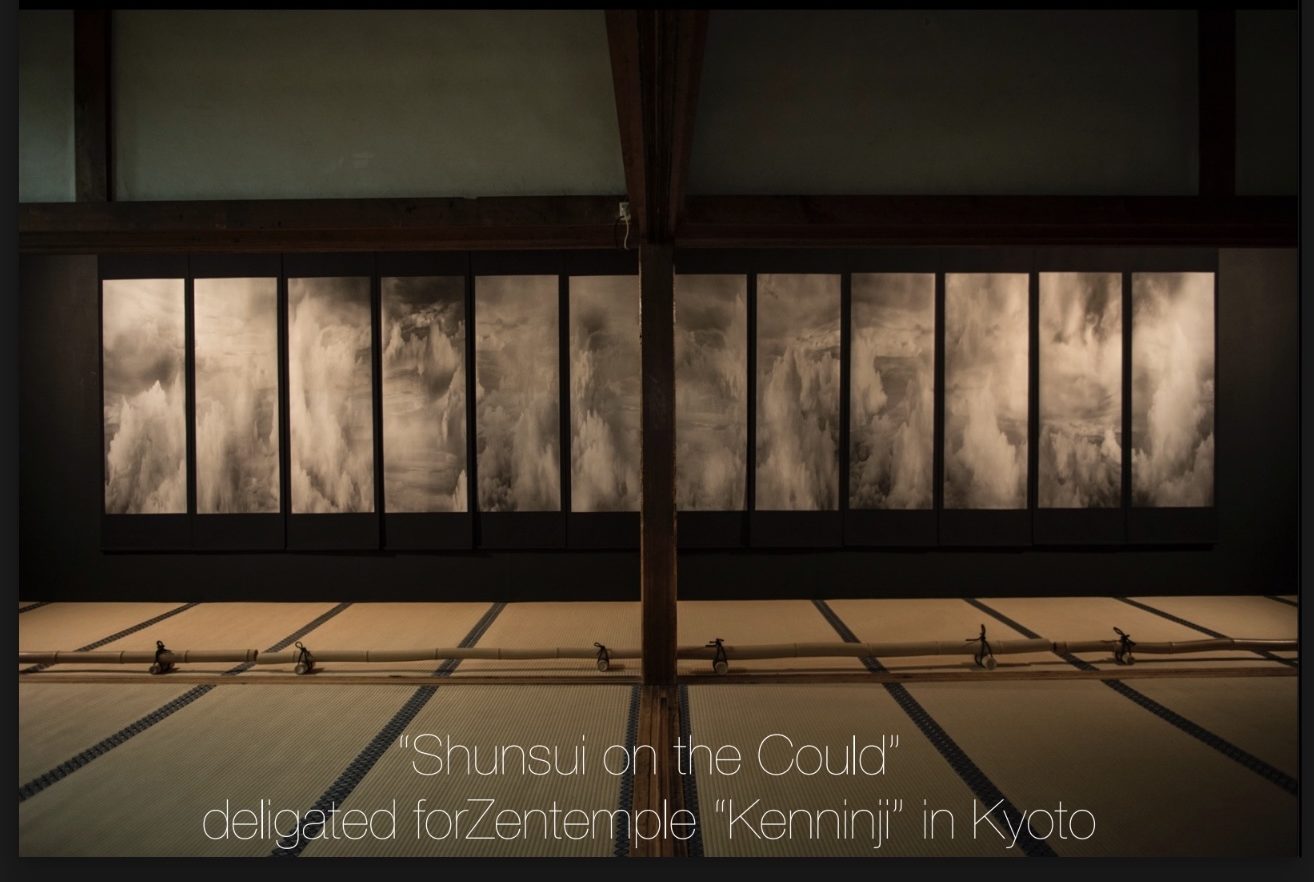
Conversely, Landscape Above the Clouds is a sansui (landscape) composed of over 1,000 photographs of clouds taken from an airplane, representing Heaven, Purgatory, and Hell from right to left. Here, the landscape is not cited as a traditional ink-wash icon. Instead, the sansui is newly generated through a modern vantage point, a moving body, and perception from the air.
Tosa does not cite Japanese culture as a set of static icons. Rather, she reconstructs stillness, disappearance, presence, the temporality of the afterlife, and the spatiality of sansui as structures of emergence. It is noteworthy that digital technology in Japanese Sanctuary is used not to showcase futurism or novelty, but to facilitate a re-experience of lost nature and the memories of a religious space.
If Sound of Ikebana is a work that extracts fleeting forms invisible to the naked eye through sound, then Silence is a work that re-establishes the existence of a lost tree within stillness. Landscape Above the Clouds does not “draw” a landscape; it creates the conditions under which a landscape is born through clouds, movement, and perspective.
Therefore, the core of this dedication can be stated as follows: Naoko Tosa uses modern technology to re-generate the invisible structures of time and spirituality inherent in Japanese culture. In this sense, Japanese Sanctuary is a significant work that expands Tosa’s theme of “emergence” from natural phenomena into the realms of Japanese culture, spirituality, and temple space. It is not a reproduction of tradition, but a work that creates the conditions for tradition to manifest once again.